
175 Clock Riddles with Answers for Kids (Easy, Funny & Hard)
Tick, tock — this page is packed with clock riddles for kids and grown-ups alike, and every single one has been wound up fresh for you. There are easy warm-ups for little learners, classic teasers in the old style, funny ones for the classroom, and a whole workshop of logical time puzzles for anyone who loves watching the hands go round.
Every riddle below is numbered, with its answer printed right underneath it — no hunting through the page, no peeking at the bottom. Read them aloud at the breakfast table, deal them out in class, or work through them one section at a time and keep score against the clock.
In total there are 175 riddles with answers, plus one Riddle of the Day with no answer printed at all and a short pit stop of real clock facts. Choose your section, set your watches, and let’s go.
🎯 Riddle of the Day
I stand taller than the grown-ups in the hall, my pendulum swings like a slow heartbeat, and once every hour I sing out the time in a deep, patient voice. What am I?
Think you know? There is no answer printed for this one — it is more fun to argue about. Take your best guess to the comments, or read it to a friend and watch them get it completely wrong first.
Clock Riddles For Kids
Friendly first tick-tocks — every answer is a clock, a part of a clock, or something a clock does. Shout out your answer before you peek!
- I hang flat on the kitchen wall and tell the whole room what time it is. What am I?
Answer: A wall clock
A wall clock hangs where everyone can glance at it — usually above the busiest room in the house. - I sit beside your bed all night, then ring my bells and shout until you wake up. What am I?
Answer: An alarm clock
An alarm clock waits quietly for the exact moment you chose, then makes as much noise as it can. - We are two pointers who travel around a face all day — one of us slow and thoughtful, one of us always in a hurry. What are we?
Answer: The clock’s hands
The short hour hand creeps while the long minute hand hurries, and together they point out the time. - I am the round front of the clock where all the numbers live. What am I?
Answer: The clock face
The face carries the numbers or marks that the hands point to as they travel round. - I am the sound a clock makes, over and over, all day and all night: tick, tock, tick, tock. What am I?
Answer: The ticking
The steady tick-tock is the sound of the clock’s machinery counting out the seconds. - I am a cheerful little clock with a tiny bird inside who pops out of a door to sing the hour. What am I?
Answer: A cuckoo clock
Cuckoo clocks come from Germany’s Black Forest, and their little bird calls out the hours. - I am a tiny clock that travels everywhere on your wrist. What am I?
Answer: A wristwatch
A wristwatch is a clock shrunk small enough to wear, so the time is always one glance away. - I swing from side to side inside a tall clock, left, right, left, right, keeping the beat. What am I?
Answer: A pendulum
A pendulum’s steady swing is what keeps a grandfather clock’s hands moving at the right speed. - I am the tallest clock in the house — so tall and grand that I stand on the floor like a grandfather. What am I?
Answer: A grandfather clock
Grandfather clocks are longcase clocks, and their deep chime has filled hallways for hundreds of years. - I have no hands at all — I simply glow with numbers that change in silence. What am I?
Answer: A digital clock
A digital clock shows the time as digits, so there are no hands to read. - I tell the time using only the sun and a shadow, and I never need a battery. What am I?
Answer: A sundial
A sundial is one of the oldest clocks of all — its shadow creeps round as the sun crosses the sky. - We are twelve friends standing in a circle, and the hands visit each of us in turn. What are we?
Answer: The numbers on the clock
The numbers 1 to 12 stand in a ring, and the hour hand points to a new one every hour. - I am the short, slow hand — I take a whole hour to crawl from one number to the next. What am I?
Answer: The hour hand
The hour hand is the shortest hand, and it makes just two full trips around the face in a whole day. - I am the longer hand, and I complete a full circle of the clock every single hour. What am I?
Answer: The minute hand
The minute hand races round once an hour — twelve times faster than the hour hand. - I am the thinnest hand of all, and I never, ever rest — I sweep past every second of the day. What am I?
Answer: The second hand
The second hand is the busiest hand on the clock, ticking off all 86,400 seconds of the day. - I am an enormous clock perched high on a tower, so big that the whole town can read me. What am I?
Answer: A clock tower
Clock towers were built so that everyone in town could see the time before watches existed. - I am the little store of power hidden inside the clock that keeps the hands moving. What am I?
Answer: The battery
When a clock’s battery runs flat, the hands slow down and stop — the clock’s way of asking for a new one. - I live in a traveller’s pocket, hanging from a chain, and my lid clicks open to show the time. What am I?
Answer: A pocket watch
Before wristwatches, gentlemen carried the time in a waistcoat pocket on a chain. - I start and stop with a click of my button, and runners use me to time their races. What am I?
Answer: A stopwatch
A stopwatch measures short stretches of time exactly, down to tiny fractions of a second. - I measure the minutes with falling sand, and when I run out you simply turn me over. What am I?
Answer: An hourglass
An hourglass counts time as sand slips through its narrow neck from the top bulb to the bottom. - I am the deep musical voice of the tower, singing out the hours across the rooftops. What am I?
Answer: The chime
A clock’s chime strikes the hour so people can hear the time even when they cannot see the clock. - I am the small round button on top of the alarm clock that buys a sleepyhead a few more minutes in bed. What am I?
Answer: The snooze button
Pressing snooze silences the alarm for a short while — but it always comes back for another try.
Clock Riddles For Kids About Time
Now we leave the clock on the wall and chase time itself — hours, days, mornings and midnights. How many can you catch?
- You cannot see me or touch me, yet everything waits for me and nobody has ever stopped me. What am I?
Answer: Time
Time touches everything, but no one has ever held it, paused it or turned it back. - I hold sixty minutes inside me, and the clock’s long hand circles me once. What am I?
Answer: An hour
One hour is sixty minutes — exactly one full lap of the minute hand. - I hold sixty seconds inside me, and there are sixty of me in every hour. What am I?
Answer: A minute
Sixty seconds make a minute, and sixty minutes make an hour — a pattern handed down from ancient Babylon. - I am the smallest piece of time on the clock — blink at the wrong moment and you will miss me completely. What am I?
Answer: A second
A second is so short that the second hand sweeps through 86,400 of them every day. - I am always coming, every single day — yet I never, ever arrive. What am I?
Answer: Tomorrow
Tomorrow is always one sleep away, because the moment it arrives it has turned into today. - Everyone alive has seen me, but I can never come back, not even for one minute. What am I?
Answer: Yesterday
Yesterday is the one day that is finished forever — it lives only in memories and photographs. - I am the day you are standing in right now — not the one behind you, not the one ahead. What am I?
Answer: Today
Today is the only day you ever actually get to use; yesterday is gone and tomorrow is a promise. - I begin when the sun climbs into the sky and the smell of breakfast fills the kitchen. What am I?
Answer: Morning
Morning runs from sunrise until noon, and it is the start of every school and working day. - I am the middle of the day, the moment when both of the clock’s hands point straight up together. What am I?
Answer: Noon
At noon the hands meet at the very top of the clock, and the sun is near its highest point. - I am the deep, dark moment when one day quietly hands over to the next. What am I?
Answer: Midnight
Midnight is 12 o’clock at night — the hinge on which one date swings into the next. - I arrive when the sun goes down and the stars clock in for their night’s work. What am I?
Answer: Night
Night is the Earth’s own shadow side, when your part of the world has turned away from the sun. - I am seven days holding hands in a row, from Monday all the way to Sunday. What am I?
Answer: A week
Seven days make a week, and there are fifty-two weeks — plus a day or two — in every year. - I am one page of the calendar, with about thirty days printed on me. What am I?
Answer: A month
Months have 28, 29, 30 or 31 days — February is the only one that changes its mind. - I contain twelve months and one whole journey of the Earth around the sun. What am I?
Answer: A year
A year is the time Earth takes to complete one full orbit of the sun: about 365 days. - I hang on the wall covered in little boxes — one box for every day of the year. What am I?
Answer: A calendar
A calendar spreads the whole year out flat so you can plan birthdays, holidays and appointments. - I visit you just once a year, and I always bring cake, candles and a song. What am I?
Answer: A birthday
A birthday marks the day you were born, and the candles count how many years you have collected. - We are the two days everyone cheers for, when school is out and the alarm clock can rest. Who are we?
Answer: The weekend
Saturday and Sunday make the weekend — the two days at the end of every working week. - I am the cosy hour when pyjamas go on, teeth are brushed and the storybook comes out. What am I?
Answer: Bedtime
Bedtime is the hour that ends a child’s day — and it always feels earlier than it should. - I am the golden moment when the sun peeks over the hills and the day begins. What am I?
Answer: Sunrise
Sunrise is when the top edge of the sun first appears over the horizon in the morning. - I paint the sky orange and pink when the sun clocks out for the day. What am I?
Answer: Sunset
Sunset is the sun sinking below the horizon — the mirror image of sunrise, twelve-ish hours later. - Every four years I sneak one extra day into February, so the calendar can catch up with the sun. What am I?
Answer: A leap year
A leap year has 366 days instead of 365, because Earth’s orbit takes about a quarter of a day longer than 365 days. - I am the short, happy pause in the school day when lessons stop and snacks appear. What am I?
Answer: Break time
Break time is the little rest between lessons — just long enough for a snack and a run around.
Classic Clock Riddles For Kids
The old favourites’ family — grand, traditional teasers in the style grandparents love. Every one here is worded fresh, but the spirit is pure classic.
- I have two hands joined to my face, yet I cannot clap, catch a ball or shake hands with you. What am I?
Answer: A clock
A clock’s hands only point — they were never made for holding anything at all. - We run in circles from morning to night, yet we never once leave the clock. What are we?
Answer: A clock’s hands
The hands travel thousands of circles in a year without moving a millimetre from the face. - I run though I have no legs, and people say I fly when they are happy — yet I have no wings. What am I?
Answer: Time
“Time flies” when you are enjoying yourself, and drags when you are bored — but it never really changes speed. - I have a face, I have hands, and I own the loudest voice in the house at seven in the morning. What am I?
Answer: An alarm clock
An alarm clock combines a face and hands with a ring loud enough to lift you out of bed. - I am a tall old gentleman who stands in the hall, swinging my pendulum and chiming out the hours. What am I?
Answer: A grandfather clock
The grandfather clock earned its name from an old song about a clock that stood in a hall for ninety years. - I tell the time with a shadow, so on dark and cloudy days I have nothing to say. What am I?
Answer: A sundial
No sunshine means no shadow, and no shadow means a sundial must stay silent. - I am the faster of two brothers — about once an hour I catch up with my slow brother and pass him. What am I?
Answer: The minute hand
The minute hand laps the hour hand roughly every 65 minutes — eleven meetings in every twelve hours. - I measure the minutes in a stream of sand, and flipping me over starts my work again. What am I?
Answer: An hourglass
Sailors, cooks and kings all timed their business with hourglasses before clocks grew clever. - I am the great bell whose deep voice rolls over the town to announce the hour. What am I?
Answer: A tower bell
Before everyone owned a watch, the tower bell was how a whole town knew the time. - At my single moment, one day ends and another begins, and most of the world is asleep. What am I?
Answer: Midnight
Midnight belongs to both days at once — the last instant of one and the first of the next. - A little wooden bird lives inside my house and pops out of a tiny door to sing the hours. What am I?
Answer: A cuckoo clock
The cuckoo pops out once for each hour — one call at one o’clock, twelve at twelve. - I am the thinnest and fastest of the three hands, forever hurrying and never allowed a rest. What am I?
Answer: The second hand
The second hand completes a full circle every minute — 1,440 circles every single day. - I count all the days of the year faithfully, yet I have no hands of my own at all. What am I?
Answer: A calendar
A calendar counts days in boxes and pages instead of hands and ticks. - I hold every birthday you have not had yet, and nobody can visit me early. What am I?
Answer: The future
The future is where all your plans live — it arrives one day at a time, never sooner. - I am made of darkness, I stretch and shrink as the sun moves, and I point to the hour without touching a thing. What am I?
Answer: A sundial’s shadow
The shadow is the sundial’s only hand — cast by a blade called a gnomon. - I am a tiny hourglass who watches over boiling eggs for exactly three minutes. What am I?
Answer: An egg timer
An egg timer is a small sandglass measured to run for the few minutes an egg needs. - I swing beneath the grandfather clock keeping the beat, steadier than any drummer. What am I?
Answer: The pendulum
Christiaan Huygens built the first pendulum clock in 1656, and clocks suddenly became far more accurate. - I have no hands and no ticking parts, only glowing numbers that change in complete silence. What am I?
Answer: A digital clock
Digital clocks replaced moving hands with numbers that simply change — no tick required. - I sleep silently all night long, then shout at exactly the moment you commanded. What am I?
Answer: An alarm
An alarm remembers one instruction all night: the exact time to wake you. - I am 365 sunrises long, and I always end with a party and fireworks. What am I?
Answer: A year
A year runs from one New Year’s Day to the next, collecting 365 sunrises on the way. - I am the direction that clock hands travel — named after them, and followed by every shadow on a sundial. What am I?
Answer: Clockwise
Clockwise means moving the way the hands move: from the top, to the right, and down around. - I strike without fists, I chime without singing, and I wake whole streets without opening my eyes. What am I?
Answer: A striking clock
A striking clock announces the hours with bells — “striking” is the clockmaker’s word for it.
Funny Clock Riddles For Kids
Warning: serious groaning ahead. These are the jokes that make long lessons feel shorter — or longer, depending on your teacher.
- Why did the clock book a doctor’s appointment?
Answer: It had far too many ticks
Ticks on the skin send anyone to the doctor — the clock just wanted its own checked too. - What did the wall clock say to the wristwatch when they met?
Answer: “Hour you doing? I minute to ask!”
Every clock greeting is a time pun waiting to happen. - Why did the clock get into trouble at school?
Answer: It kept tocking back to the teacher
Tick-tock, tick-tock — the clock simply cannot stop answering back. - Why is the alarm clock always so grumpy first thing in the morning?
Answer: Because the moment it opens its mouth, somebody hits it
Being smacked on the head every time you speak would make anyone grumpy. - Why did the clock apply for a job?
Answer: It wanted to make every second count
A clock with ambition knows its seconds are valuable. - What did one clock hand say to the other clock hand?
Answer: “We have got to stop meeting like this — eleven times a day is plenty!”
The two hands really do meet eleven times in every twelve hours. - Why did the old grandfather clock finally retire?
Answer: It had done its time
Ninety years of ticking is enough service for any clock. - Why did the cuckoo clock book a holiday?
Answer: It was going cuckoo from working around the clock
Even a cuckoo needs a break from popping out every hour. - Why did the clock’s hands refuse to work one morning?
Answer: They had gone round in circles all year without a single day off
Even clock hands dream of a holiday — preferably somewhere with no numbers. - Why do clocks never lose their temper during a long, boring wait?
Answer: They take everything one tick at a time
Patience is built into a clock — it can only ever do one tick, then the next. - What did the digital clock say to the grandfather clock?
Answer: “Look at me, Grandpa — no hands!”
The youngest clocks are very proud of their glowing numbers. - Why does the minute hand always win its races against the hour hand?
Answer: It moves twelve times faster than its brother
The minute hand laps the whole face in an hour; the hour hand needs twelve hours for the same trip. - Why did the clock carry a ladder to work?
Answer: It wanted to climb right to the top of the hour
Every ambitious clock dreams of reaching twelve. - What do you call a belt made entirely out of watches?
Answer: A waist of time
It holds up your trousers and wastes your minutes at the same time. - Why did the school clock get a detention?
Answer: It struck twelve right in the middle of a lesson
Striking is the clock’s job, but the teacher still wrote it up. - What did the hour hand shout when it finally caught up with the minute hand?
Answer: “Got you at last — same place again in about an hour!”
The hands meet, part, and meet again roughly every sixty-five minutes. - Why do clocks make hopeless secret-keepers?
Answer: Their hands are always pointing at things, and their ticks give everything away
A clock announces everything it knows, loudly, all day long. - Why did the alarm clock deserve a medal?
Answer: It rose to the occasion every single morning
Nobody in the house rises earlier or more bravely than the alarm clock. - What is a clock’s favourite snack at a party?
Answer: Second helpings
A clock can never resist seconds — it counts them all day. - Why did the sundial refuse to go to work on Monday?
Answer: The forecast said cloudy, and without sunshine it had nothing to do
A sundial on a grey day is a clock with the day off. - What did the clock say at the end of a very long day?
Answer: “I am completely wound up — time to unwind!”
Spring-driven clocks are wound up tight, then slowly unwind as they tick. - How do friendly clocks say goodbye to each other?
Answer: “See you in a minute!”
For a clock, a minute is the politest promise of all.
Logical Clock Riddles For Students
Sharpen your pencils — these need real clock maths. Every answer below has been worked out and checked, so no peeking until you have done the sums.
- The clock shows exactly 3:00. What is the angle between the two hands?
Answer: 90 degrees
At 3:00 the hour hand points at the 3 and the minute hand at the 12 — a perfect right angle. - The clock shows exactly 6:00. What is the angle between the two hands?
Answer: 180 degrees
At 6:00 the hands point in exactly opposite directions, making one straight line. - The clock shows exactly 2:00. What is the angle between the two hands?
Answer: 60 degrees
Each hour mark is worth 30 degrees, and at 2:00 the hands sit two marks apart: 2 × 30 = 60. - The clock shows exactly 4:00. What is the angle between the two hands?
Answer: 120 degrees
Four hour marks apart means 4 × 30 = 120 degrees — wider than a right angle. - The clock shows 2:30. What is the angle between the two hands?
Answer: 105 degrees
At 2:30 the minute hand points at the 6 (180°) while the hour hand has crept halfway past the 2 (75°), and 180 − 75 = 105. - A clock in an advert shows 10:10. What is the angle between its hands?
Answer: 115 degrees
At 10:10 the hour hand sits at 305° and the minute hand at 60°, so the smaller angle between them is 115 degrees. - In twelve hours, how often do the two hands lie exactly on top of each other?
Answer: 11 times
The hands meet about every 65 minutes, not every 60 — so one meeting is “missing” in each twelve hours. - In a whole day and night, how often do the clock’s hands overlap?
Answer: 22 times
Eleven meetings in the first twelve hours and eleven more in the second makes twenty-two in a full day. - In twelve hours, how often do the two hands make a perfect right angle?
Answer: 22 times
The hands form a right angle twice in most hours, adding up to twenty-two in every twelve hours. - Count up every single second in one full day. What is the total?
Answer: 86,400 seconds
Sixty seconds × sixty minutes × twenty-four hours = 86,400 — every one of them ticked by the second hand. - How many minutes are there in one full day?
Answer: 1,440 minutes
Sixty minutes in an hour, twenty-four hours in a day: 60 × 24 = 1,440. - How many hours are there in a whole week?
Answer: 168 hours
Twenty-four hours in a day and seven days in a week: 24 × 7 = 168. - How many seconds tick by in one hour?
Answer: 3,600 seconds
Sixty seconds in every minute and sixty minutes in every hour: 60 × 60 = 3,600. - It is 9:00 now. Exactly five hours pass — what time is it then?
Answer: 2:00
Nine plus five makes fourteen, and fourteen o’clock on a twelve-hour clock is 2:00. - How many minutes pass between 7:20 and 8:05?
Answer: 45 minutes
From 7:20 to 8:00 is forty minutes, plus five more minutes to reach 8:05. - How many degrees does the minute hand sweep in ten minutes?
Answer: 60 degrees
The minute hand moves 6 degrees every minute, so in ten minutes it sweeps 10 × 6 = 60 degrees. - How many degrees does the hour hand move in one whole hour?
Answer: 30 degrees
The hour hand must cover 360 degrees in twelve hours, so it creeps just 30 degrees per hour. - If you add up all twelve numbers on a clock face, what total do you get?
Answer: 78
1 + 2 + 3 all the way to 12 makes 78 — pair them up (1 + 12, 2 + 11…) and each pair makes 13. - A clock has stopped completely, but it is not useless — how many times a day does it show the right time?
Answer: Twice a day
A stopped clock’s hands point at one fixed time, and the real day passes that time twice. - On a twelve-hour digital clock, how many times a day does the display read exactly 11:11?
Answer: Twice a day
It reads 11:11 once in the morning and once at night — a favourite moment for making wishes. - A film starts at 6:15 and lasts exactly fifty minutes. At what time does it end?
Answer: 7:05
6:15 plus forty-five minutes reaches 7:00, and the last five minutes carry it to 7:05. - The hands of a clock have just overlapped. Roughly how long until they overlap again?
Answer: About 65 minutes
The minute hand needs a full extra lap to catch up, which takes about sixty-five minutes — precisely 65 minutes and 27 seconds or so.
Clock Riddles With Answers
A mixed cabinet of time curiosities — famous bells, ancient clocks and clever inventions. Every answer is printed right below, as promised.
- I tick a perfectly steady beat so musicians can keep their music in time. What am I?
Answer: A metronome
A metronome swings or clicks at a set speed, and music students practise with its beat. - People think I am a famous tower in London, but really I am the great bell inside it, booming out the hours. What am I?
Answer: Big Ben
Big Ben is the nickname of the Great Bell — the tower it hangs in is the Elizabeth Tower. - I am a double-faced clock that chess players slap after every move, so their thinking time runs out fairly. What am I?
Answer: A chess clock
A chess clock holds two timers; pressing your button stops your clock and starts your opponent’s. - Long before springs and batteries, I measured the hours by letting water drip steadily from jar to jar. What am I?
Answer: A water clock
Water clocks — clepsydras — timed speeches and night watches in the ancient world. - I am the most accurate clock humans have ever built — I count the tiny vibrations of atoms and would barely drift in millions of years. What am I?
Answer: An atomic clock
Atomic clocks keep the world’s official time and steer the satellites that give us maps and directions. - We are the letters some grand old clocks use instead of ordinary numbers: I, V, X and L among us. What are we?
Answer: Roman numerals
Many clock faces use Roman numerals — though clockmakers traditionally write four as IIII instead of IV. - I am the triangular blade standing in the middle of a sundial, and my shadow does all the talking. What am I?
Answer: A gnomon
The gnomon’s shadow falls across the sundial’s hour lines as the sun moves across the sky. - I am an invisible band around the Earth inside which every clock agrees on the same time. What am I?
Answer: A time zone
The Earth is divided into time zones so that noon lands near the middle of the day everywhere. - I am the invisible line running through Greenwich in London where the world’s time zones begin their counting. What am I?
Answer: The Prime Meridian
Every time zone on Earth is counted in hours ahead of or behind the time on this line. - I am the chart pinned up in stations that gives every train and bus its leaving time. What am I?
Answer: A timetable
A timetable is a clock turned into a list — every departure written against its hour and minute. - I count backwards — ten, nine, eight — until the great moment arrives and the rocket roars away. What am I?
Answer: A countdown
A countdown measures the time remaining before an event instead of the time that has passed. - I am the working day that begins when everyone else is going to bed, lit by lamps and moonlight. What am I?
Answer: The night shift
Night-shift workers keep hospitals, bakeries and railways running while the town sleeps. - We ring out from the church tower to call the village together and to mark the passing hours. What are we?
Answer: Church bells
Church bells have announced services, weddings and the hours for centuries. - I am the little key that feeds an old clock its strength — turn me, and the spring inside winds tight. What am I?
Answer: A winding key
Before batteries, clocks were wound with a key every day or every week to keep them ticking. - I am a wheel covered in teeth, passing the clock’s tick from one wheel to the next inside the case. What am I?
Answer: A gear
Gears with different numbers of teeth trade speed for strength all through a clock’s movement. - I am a coiled ribbon of steel hidden in the clock, quietly storing all of its power. What am I?
Answer: The mainspring
As the mainspring slowly uncoils, it drives the gears — winding the clock coils it tight again. - I am the journey every storybook hero longs to take — a trip into yesterday or a leap into tomorrow. What am I?
Answer: Time travel
No one has built a working time machine, but clocks are where the daydream always starts. - We are the four chapters of every year, told in blossom, sunshine, falling leaves and frost. What are we?
Answer: The seasons
Spring, summer, autumn and winter turn like the hands of a very slow clock, once a year. - I ring to start the lessons, ring again for lunch, and ring one last time for home. What am I?
Answer: The school bell
The school bell slices the day into lessons more strictly than any clock on the wall. - I speak the time aloud at the press of a button, for people who cannot see a clock’s face. What am I?
Answer: A talking clock
Talking clocks announce the hour in a clear voice — a friendly invention for blind people. - I am a row of clocks on an airport wall, each one showing a different city, all at the same moment. What am I?
Answer: A world clock
A world clock lets travellers compare times in London, Dubai, New York and Tokyo at a glance. - I am the ancient old man with a long beard, a scythe and an hourglass, who stands for time itself. Who am I?
Answer: Father Time
Father Time appears in stories and New Year pictures as the old year handing over to the new.
Clock Riddles for Adults
The grown-ups’ hour: deadlines, date lines and the strange behaviour of time itself. Keys and calendars are no excuse for peeking.
- People swear I have wings whenever they are enjoying themselves, yet I have no feathers and cannot fly. What am I?
Answer: Time
“Time flies” is the old saying — fun makes the hours feel fast, though the clock never speeds up. - I am the line at work that nobody may step over late — cross me, and there is trouble. What am I?
Answer: A deadline
A deadline is the final moment by which a task must be finished, named after a line prisoners once could not cross. - I am the extra hours you stay at your desk after the clock has said it is home time. What am I?
Answer: Overtime
Overtime is work done beyond the normal hours — often paid at a higher rate for the trouble. - I am the button that buys a tired worker a few more minutes of dreams before the alarm insists. What am I?
Answer: The snooze button
Snooze is the alarm clock’s little bribe: a few more minutes now, in exchange for a bigger rush later. - I am the exhaustion that follows you home from a long flight, because your body clock is still living in another city. What am I?
Answer: Jet lag
Jet lag strikes when your inner clock and the local clock disagree about when to sleep. - Twice a year I steal an hour from whole countries, then quietly give it back months later. What am I?
Answer: Daylight saving time
Clocks spring forward one hour in spring and fall back in autumn, shifting daylight into the evening. - I am a sealed box of today’s treasures, buried for people who will not open it for a hundred years. What am I?
Answer: A time capsule
Time capsules carry letters, photographs and everyday objects forward to a chosen future date. - I am called an hour, yet in me every car in the city crawls at walking pace. What am I?
Answer: Rush hour
Rush hour is the busiest traffic time of day — and usually the slowest hour of all. - Cross me travelling west and a whole day vanishes from your calendar; cross me travelling east and yesterday comes back. What am I?
Answer: The International Date Line
The Date Line zigzags down the Pacific, keeping the world’s calendars one day apart on either side. - I am the extra time you live on after the deadline has already passed — a gift that cannot last. What am I?
Answer: Borrowed time
To live on borrowed time is to continue beyond the moment something was expected to end. - The more you stare at me during a dull meeting, the slower I seem to move. What am I?
Answer: A watched clock
A watched clock never boils, as the saying goes — attention makes the minutes feel longer. - In the business world I am spent, saved, wasted and budgeted, exactly as if I were money. What am I?
Answer: Time
“Time is money” is the business motto — so wasting either one costs the same. - When I strike thirteen, everyone who hears me knows at once that something is wrong with me. What am I?
Answer: A faulty clock
No real clock strikes thirteen — the impossible chime is the classic sign of a broken one. - I am the golden clock a loyal worker dreams of receiving after forty years of service. What am I?
Answer: The retirement clock
A presentation clock is the traditional gift marking the end of a long career. - I am the famous thief who steals your hours while sweetly promising you will start tomorrow. What am I?
Answer: Procrastination
Procrastination is called the thief of time — it steals hours by always offering tomorrow instead. - I hang in a barber’s shop with my numbers written backwards, so the customer in the chair can read me in the mirror. What am I?
Answer: A reverse clock
Barbers’ clocks are printed in mirror writing so they read correctly when seen in the looking glass. - I am the very last possible moment to act, named after the clock’s own eleventh hour. What am I?
Answer: The eleventh hour
To do something at the eleventh hour is to do it just before it is too late. - I stamp the card that proves exactly when your working day began and when it ended. What am I?
Answer: A time clock
Factory and office time clocks punch arrival and leaving times onto workers’ cards. - I am the evening stretch of hours when television audiences swell to their largest. What am I?
Answer: Prime time
Prime time is the broadcaster’s golden slot — the hours when the most people are watching. - I am the moment the shopkeeper locks the door, stacks the chairs and turns the sign to Closed. What am I?
Answer: Closing time
Closing time ends the trading day — the shop’s own daily deadline. - The older you grow, the faster I seem to run — though your own legs only slow down. What am I?
Answer: Time
Each new year is a smaller fraction of a longer life, which is why the years feel quicker as we age.
Hard Clock Riddles With Answers
The deep end of the pool: mirror clocks, striking bells and clocks that lie. Think slowly — the clock is watching.
- A sundial has no moving parts at all. Which everyday timepiece has the most moving parts of all?
Answer: An hourglass
Every grain of sand inside an hourglass is a moving part — thousands of them in a single turn. - You glance at a clock in a mirror and it reads exactly 3:00. What is the real time?
Answer: 9:00
A mirror flips the face left-to-right, so the real time is twelve minus the reflected time: 12 − 3 = 9. - A clock seen in a mirror reads 2:30. What is the real time?
Answer: 9:30
Subtract the mirror reading from 11:60: 11:60 − 2:30 = 9:30 — the reflection’s hidden truth. - Striking six o’clock takes a tower clock five seconds. How many seconds does it need to strike twelve?
Answer: 11 seconds
Six strikes have only five gaps between them — one second each — so twelve strikes have eleven gaps: eleven seconds. - In twelve hours the hands meet only eleven times, not twelve. Which stretch of the clock steals the missing meeting?
Answer: The stretch between 11 and 1
The hands meet at about 12:00 itself, so no separate meeting fits between eleven and one — one hour in twelve has none. - During a whole day, how often do the hands of a clock stand at a perfect right angle?
Answer: 44 times
Twenty-two right angles in each twelve hours doubles to forty-four across a full day. - Counting both overlaps and opposite points, how many times do the hands form one straight line in twelve hours?
Answer: 22 times
Eleven overlaps plus eleven exact oppositions make twenty-two straight lines in twelve hours. - A clock gains exactly one minute every day. Starting correct today, how long until it shows the right time again?
Answer: 720 days
It must gain a full twelve hours — 720 minutes — before a twelve-hour clock reads correctly again: one minute a day takes 720 days. - A faulty clock loses five minutes every hour. After half a day, how far behind the real time is it?
Answer: One hour
Five minutes lost twelve times over is sixty minutes — the clock trails a full hour behind by the half-day mark. - The clock shows 7:20. What is the angle between the hands?
Answer: 100 degrees
At 7:20 the hour hand has reached 220° and the minute hand 120°, leaving exactly 100 degrees between them. - The clock shows 8:40. What is the angle between the hands?
Answer: 20 degrees
At 8:40 the hour hand sits at 260° and the minute hand at 240° — just twenty degrees apart, nearly touching. - How many degrees does the minute hand sweep in twenty-five minutes?
Answer: 150 degrees
At six degrees per minute, twenty-five minutes sweeps 25 × 6 = 150 degrees — a quarter past a full half-turn. - It is now 9:00. How many degrees has the hour hand travelled since 6:00?
Answer: 90 degrees
Three hours at thirty degrees per hour gives ninety degrees — a quarter of the whole face. - Sam sets his old wind-up alarm for 9 o’clock and climbs into bed at 8 in the evening. How long does he sleep?
Answer: One hour
A wind-up clock cannot tell evening from morning, so the alarm rings at 9 the same evening — after just one hour. - Some months have thirty days and some have thirty-one. How many months have exactly twenty-eight days?
Answer: All twelve of them
Every month has at least twenty-eight days — February is merely the only one that stops there (except in leap years). - A tower clock strikes the hours, once at one, twice at two, and so on. How many strikes does it make from 6 in the morning to 6 in the evening, striking both sixes?
Answer: 84 strikes
Morning to noon gives 6 + 7 + 8 + 9 + 10 + 11 + 12 = 63, and the afternoon adds 1 + 2 + 3 + 4 + 5 + 6 = 21, totalling 84. - Between 8 and 9 o’clock, at about what time do the two hands lie exactly on top of each other?
Answer: At about twenty-two minutes to nine — roughly 8:44
The minute hand catches the hour hand at about 8:43 and 38 seconds, so “just before twenty to nine” earns full marks. - Two straight lines can split a clock face into three parts so that the numbers in each part add up to the same total. What is that total?
Answer: 26
All twelve numbers add to 78, and 78 ÷ 3 = 26 — one part is 11 + 12 + 1 + 2, another 10 + 9 + 3 + 4, the last 8 + 7 + 6 + 5. - How many times a day does a twelve-hour digital clock show a time built from one digit repeated, like 1:11 or 5:55?
Answer: 12 times a day
1:11, 2:22, 3:33, 4:44, 5:55 and 11:11 make six in each twelve hours — twelve across the whole day. - At about what time, with the hour hand between 9 and 10, do the hands point in exactly opposite directions?
Answer: At about sixteen minutes past nine — roughly 9:16
The hands stand exactly opposite at about 9:16 and 22 seconds, one of their eleven face-to-face meetings in every twelve hours. - Counting one leap year, how many days are there in four years altogether?
Answer: 1,461 days
Three ordinary years give 365 × 3 = 1,095 days, and the leap year adds 366: 1,095 + 366 = 1,461. - A clock’s minute hand moves twelve times faster than its hour hand. While the hour hand turns through 30 degrees, how far does the minute hand turn?
Answer: 360 degrees — one full circle
Thirty degrees of hour-hand travel takes a whole hour, and in a whole hour the minute hand makes exactly one complete lap.
🕰️ Clock Facts for Curious Minds
Five real facts to refuel with — every one of them checked, not invented:
- The two hands of a clock lie exactly on top of each other only 11 times in twelve hours — 22 times in a full day, not the 44 people often guess. (The number 44 belongs to the right angles: the hands make a perfect right angle 44 times a day.)
- A single day holds 86,400 seconds — and the second hand of a clock ticks through every last one of them.
- The sixty-minute hour is a gift from the ancient Babylonians, who counted in sixties; their system still runs every clock on Earth.
- Big Ben is not the tower and not the clock — it is the nickname of the Great Bell that strikes the hours inside London’s Elizabeth Tower.
- The words “minute” and “second” come from Latin: a minute was the pars minuta prima, the “first small part” of an hour, and a second was the pars minuta secunda, the “second small part”.
And when your brain needs a change of pace, take our car riddles for a spin around the block, or slow right down and think like a detective with our psychopath riddles, where every clue matters.
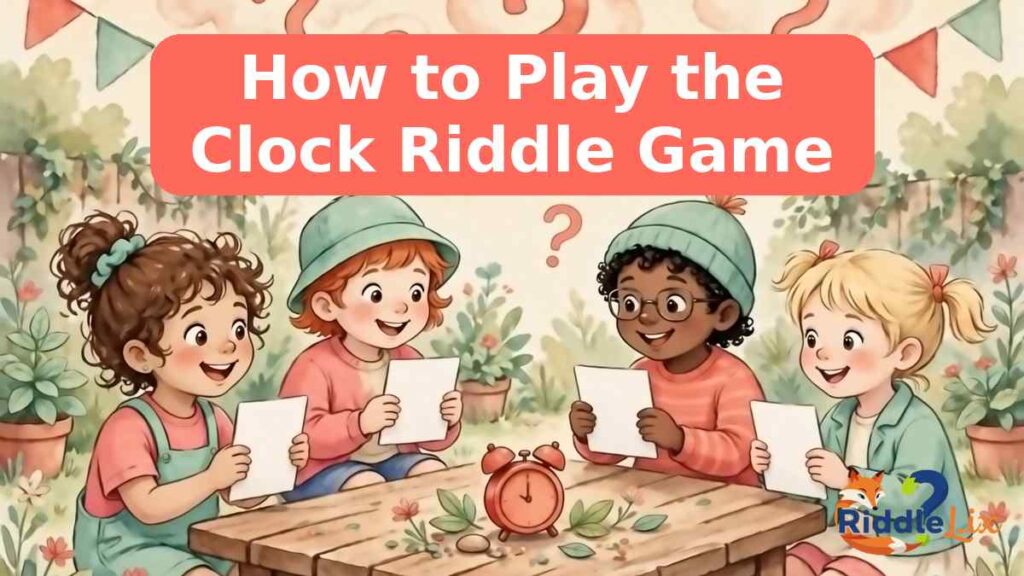
🎮 How to Play the Clock Riddle Game
- Pick a timekeeper. One player reads the riddles aloud and guards the answers, while everyone else races the clock as guessers.
- Set the peek rule. Every guesser gets three questions and three tries before anyone is allowed to peek at the answer.
- Beat the clock. One point for a correct answer, two points if you get it before the timekeeper counts to ten, and a bonus point if you can explain exactly why the answer fits.
- Change the theme. After the clock round, cool off with our water riddles, where every answer runs, splashes or flows, or wander through our flower riddles for a gentler round in the garden.
- Crown the champion. The player with the most points becomes chief timekeeper — and reads the riddles in the next round.
✍️ Make Your Own Clock Riddle
- Choose a clock or a piece of time. A pendulum, an alarm bell, a whole leap year — anything with a job to do.
- List what it does. Where does it live? What does it see? What happens if it stops?
- Turn the facts into clues. Describe the job without saying the name: “I swing and keep the beat” instead of “I am a pendulum.”
- Hide the easiest clue last. Put the giveaway detail at the end so guessers work for it.
Want to see the hiding trick done at full speed? Our football riddles keep the competition fierce from the first whistle, while our stupid riddles play the whole game purely for laughs.
FAQs
What are clock riddles?
Clock riddles are brain teasers about clocks, their hands and parts, and about time itself. Some describe a clock in disguise — “I swing and keep the beat” — while others are jokes, word puzzles or little maths problems about hours and angles. Every riddle on this page has its answer printed directly underneath it, so nobody is ever left stuck.
Are clock riddles suitable for all age groups?
Yes — the sections are graded, so there is something for everyone. Young children can start with the Clock Riddles For Kids and About Time sections, older students can wrestle with the Logical and Hard sets, and the Adults section is full of wordplay about deadlines, time zones and jet lag that grown-ups will recognise from their own lives.
How can I use clock riddles in teaching?
Clock riddles are a natural fit for lessons on telling the time and on angles. Read one aloud as a lesson starter, let pairs race to solve the Logical set with a real classroom clock in hand, or finish a maths topic by having pupils work out the angle between the hands at different times — the answers and workings are printed under every riddle on this page.
How can I help my kids to solve clock riddles?
Start with a real clock they can touch: move the hands, count the numbers, and watch the minute hand lap the hour hand. Encourage them to say the clues out loud and to guess the family first — is it a part of the clock, a kind of clock, or a piece of time itself? If a riddle stalls, reveal one clue at a time rather than the whole answer.
Are there benefits to solving clock riddles?
Plenty. Clock riddles build time-telling fluency, mental maths (the Logical section is full of angles, totals and overlaps), careful reading and lateral thinking — all inside a game. Because every answer is printed with a one-sentence explanation, children also pick up real clock facts as they play, from the 86,400 seconds in a day to why the hands meet only eleven times in twelve hours.
Conclusion
That is the full twelve hours: 175 clock riddles with answers, every one of them wound up fresh — hands and pendulums, bells and birthdays, mirror clocks and striking towers, all solved by listening to the clues and thinking like the thing itself. Play them against the clock at breakfast, deal them out in class, or save the Hard set for the friend who claims to be good at maths.
If all this ticking has made you curious about the machine itself, the long story of the clock — from sundials and dripping water clocks to the atomic clocks that run the modern world — is the perfect next read. Then come back, pick your favourite riddle from this page, and challenge a friend to beat your best time.