300+ Science Riddles with Answers for Kids & Adults
Science Riddles are fun questions that test your science knowledge. They help you learn about nature, space, animals, and the human body. Science Riddles make learning easy, exciting, and enjoyable for everyone.
Are you ready to challenge your brain with fun science puzzles? Every riddle makes you think in a new and creative way. Solve them and see how many clever answers you can find.
Science Riddles are perfect for kids, students, teachers, and families. They improve thinking skills while making science more interesting. Enjoy these fun riddles and discover amazing science facts every day.
Science Riddles For Kids
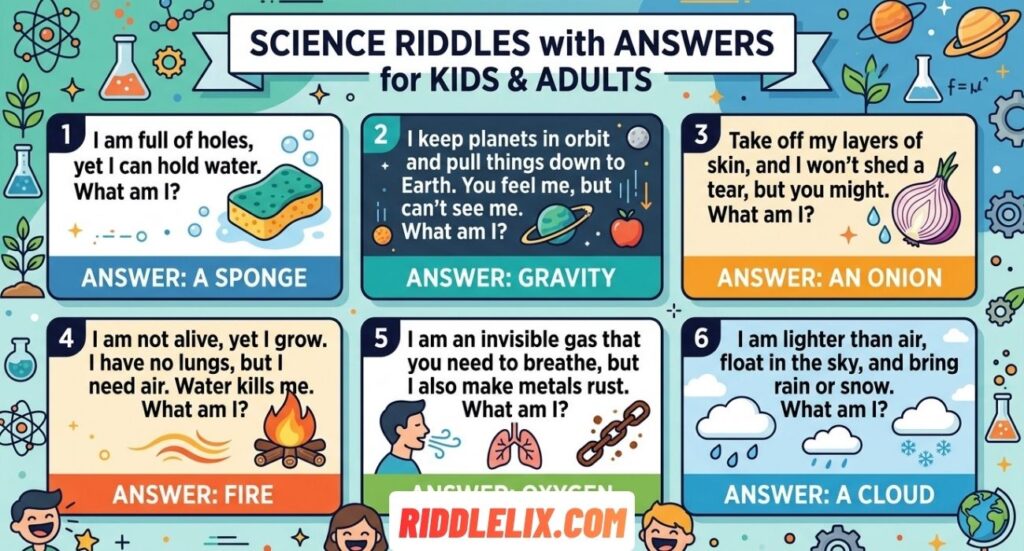
This section introduces simple and fun science riddles for kids. These puzzles use easy words and everyday ideas to help young learners think about basic science concepts like animals, weather, and the human body. They are perfect for classroom activities or bedtime fun.
- I have a face and two hands, but no arms or legs. I help you know when to wake up and when to sleep. What am I?
Answer: A clock. Clocks measure time, which is an important concept in physics and daily life. - I am full of holes, but I can still hold water. What am I?
Answer: A sponge. Sponges have tiny pores that trap liquid through surface tension and absorption. - I fall from the sky, but I never get hurt. I can make you wet, but I am not solid. What am I?
Answer: Rain. Rain is liquid water that falls from clouds during the water cycle. - The more you take away from me, the bigger I become. What am I?
Answer: A hole. Digging removes dirt or material, making a hole larger through displacement. - I am hot during the day and cool at night. I help plants grow and give you light. What am I?
Answer: The sun. The sun provides solar energy that drives photosynthesis in plants. - I have a spine, but I am not an animal. I hold many pages, but I am not a notebook. What am I?
Answer: A book. The spine of a book is the edge where pages are bound together. - You cannot see me, but I fill every room. I am essential for life, yet you cannot hold me. What am I?
Answer: Air. Air is a mixture of gases like oxygen and nitrogen that surrounds the Earth. - I am white and fluffy, but I am not a pillow. I float in the sky and sometimes bring rain. What am I?
Answer: A cloud. Clouds are made of tiny water droplets or ice crystals suspended in the atmosphere. - I have roots, a stem, and leaves, but I do not walk or talk. What am I?
Answer: A plant. Plants are living organisms that make their own food through photosynthesis. - I am always moving, even when you are still. I can be fast or slow, but you cannot stop me. What am I?
Answer: Time. Time is a fundamental measurement in physics that always moves forward. - I am in your body and I beat all day long. I pump blood and keep you strong. What am I?
Answer: The heart. The heart is a muscular organ that circulates blood through the body. - I am frozen water, but I float on liquid water. What am I?
Answer: Ice. Ice is less dense than liquid water, which is why it floats. - I live in the sky and make loud noises. I flash with light before you hear my voice. What am I?
Answer: Lightning. Lightning is an electrical discharge that heats the air and creates thunder. - I have no mouth, but I can eat rocks. I am a strong force of nature. What am I?
Answer: Erosion. Wind and water wear down rocks over time through erosion. - I am a giant ball of gas that twinkles at night. What am I?
Answer: A star. Stars are massive spheres of hot plasma that produce light through nuclear fusion.
Best Science Riddles For Kids
Here are the best science riddles for kids that teachers and parents love to use. These puzzles are engaging, educational, and easy to understand. They cover topics like animals, space, weather, and simple physics concepts that children learn in school.
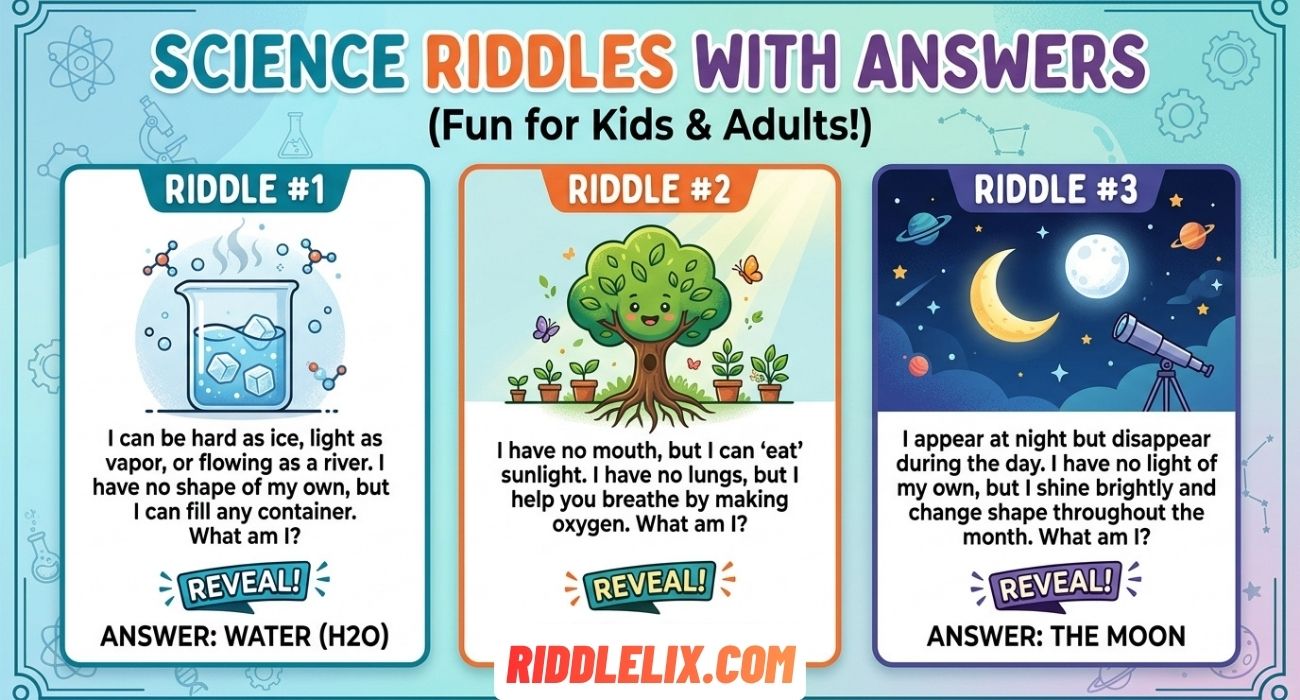
- I orbit the Earth and control the tides. You see me mostly at night. What am I?
Answer: The moon. The moon’s gravity pulls on Earth’s oceans, creating high and low tides. - I am a gas that plants need to survive. Humans and animals release me when they breathe out. What am I?
Answer: Carbon dioxide. Plants absorb carbon dioxide during photosynthesis to make food. - I can be solid, liquid, or gas. I cover most of the Earth and you drink me every day. What am I?
Answer: Water. Water exists in three states of matter and covers about 71 percent of Earth’s surface. - I am a force that pulls things down. Without me, you would float away. What am I?
Answer: Gravity. Gravity is the force of attraction between objects with mass, discovered by Isaac Newton. - I am invisible, but I can bend light. I can make a straw look broken in a glass. What am I?
Answer: Refraction. Refraction happens when light passes from one medium to another and changes speed. - I am the center of our solar system. All planets revolve around me. What am I?
Answer: The sun. The sun contains over 99 percent of the total mass in our solar system. - I am made of ice, dust, and rock. I have a glowing tail when I get close to the sun. What am I?
Answer: A comet. Comets heat up near the sun, releasing gas and dust that form a visible tail. - I am a tiny building block of life. You need a microscope to see me. What am I?
Answer: A cell. Cells are the basic structural and functional units of all living organisms. - I am a type of energy you can hear. I travel in waves through air and water. What am I?
Answer: Sound. Sound energy travels as vibrations through different materials like air, water, and solids. - I am the hardest natural substance on Earth. I sparkle and shine on rings. What am I?
Answer: A diamond. Diamonds are made of carbon atoms arranged in a crystal structure under extreme pressure. - I am a planet known for my beautiful rings. I am the sixth planet from the sun. What am I?
Answer: Saturn. Saturn’s rings are made of ice particles, rocky debris, and dust. - I am a process where a caterpillar changes into a butterfly. What am I?
Answer: Metamorphosis. Metamorphosis is a biological transformation that some insects undergo during their life cycle. - I am a mixture of gases that protects Earth from harmful sun rays. What am I?
Answer: The ozone layer. The ozone layer absorbs most of the sun’s harmful ultraviolet radiation. - I am a machine that helps you see tiny things up close. I use lenses to magnify objects. What am I?
Answer: A microscope. Microscopes use optical lenses to enlarge small specimens for scientific study. - I am the force that makes a magnet stick to a fridge. What am I?
Answer: Magnetism. Magnetism is a physical force produced by moving electric charges that attracts certain metals.
Science Riddles With Answers
This part gives you a mix of science riddles with answers that are perfect for quizzes and games. These puzzles cover chemistry, biology, physics, and earth science. You can use them for trivia nights or to challenge your friends.
- I am the only planet that is known to have life. What am I?
Answer: Earth. Earth has liquid water, a breathable atmosphere, and a suitable climate for living organisms. - I am a chemical reaction that produces heat and light. You use me to cook food and stay warm. What am I?
Answer: Fire. Fire is rapid oxidation of a material that releases heat, light, and various gases. - I am the smallest unit of matter. Everything is made of me. What am I?
Answer: An atom. Atoms are the basic building blocks of matter, made of protons, neutrons, and electrons. - I am a type of rock formed from cooled lava. What am I?
Answer: Igneous rock. Igneous rocks form when molten magma or lava cools and solidifies. - I am a gas that humans need to breathe to stay alive. What am I?
Answer: Oxygen. Oxygen is essential for cellular respiration, which produces energy in living cells. - I am a device that measures temperature. You might use me when you feel sick. What am I?
Answer: A thermometer. Thermometers measure how hot or cold something is using a scale like Celsius or Fahrenheit. - I am a type of energy that powers your TV and lights. I flow through wires. What am I?
Answer: Electricity. Electricity is the flow of electric charge through a conductor like copper wire. - I am a natural disaster caused by shifting tectonic plates. I make the ground shake. What am I?
Answer: An earthquake. Earthquakes release stored energy in Earth’s crust, creating seismic waves. - I am a group of stars that form a pattern in the night sky. What am I?
Answer: A constellation. Constellations are recognizable star patterns named by ancient cultures for navigation and storytelling. - I am a type of rock formed by heat and pressure deep underground. What am I?
Answer: Metamorphic rock. Metamorphic rocks change from existing rock types due to extreme heat and pressure. - I am the process plants use to make their own food using sunlight. What am I?
Answer: Photosynthesis. During photosynthesis, plants convert carbon dioxide and water into glucose and oxygen using sunlight. - I am the study of matter and how it changes. You might mix chemicals in my lab. What am I?
Answer: Chemistry. Chemistry explores the composition, structure, properties, and reactions of matter. - I am the path an object takes when it goes around another object in space. What am I?
Answer: An orbit. An orbit is the curved trajectory of an object around a star, planet, or moon due to gravity. - I am a type of animal that can live both in water and on land. What am I?
Answer: An amphibian. Amphibians like frogs and salamanders spend part of their life in water and part on land. - I am the force that opposes motion between two surfaces. I slow things down. What am I?
Answer: Friction. Friction converts kinetic energy into heat and resists the sliding movement of objects.
Tricky Science Riddles For Kids
These tricky science riddles for kids are designed to make young minds think twice. The answers are not always obvious, so children need to use logic and reasoning. These puzzles are great for developing problem-solving skills in elementary and middle school students.
- I can be broken without being touched. What am I?
Answer: A promise. This is a trick question that plays on words, but silence or a wave can also break without physical contact. - What has a bottom at the top?
Answer: A leg. This tricky riddle plays with the word bottom, which refers to the foot or bottom part of a leg. - I get shorter as I get older. What am I?
Answer: A candle. A candle burns down and becomes shorter over time through a combustion reaction. - What has hands but cannot clap?
Answer: A clock. A clock has hour and minute hands but cannot move them together to clap. - I have a neck but no head, and I wear a cap. What am I?
Answer: A bottle. A bottle has a narrow neck and a cap but no head like a living creature. - The more you take, the more you leave behind. What am I?
Answer: Footsteps. Every step you take leaves a footprint behind, creating a path as you move forward. - What has a ring but no finger?
Answer: A telephone. A telephone rings to signal an incoming call, but the ring is a sound, not jewelry. - I can fill a room but take up no space. What am I?
Answer: Light. Light illuminates an entire room instantly without occupying physical volume. - What runs around a field but never moves?
Answer: A fence. A fence borders a field and seems to run around it, but the fence stays in one place. - What has teeth but cannot bite?
Answer: A comb. A comb has teeth-like projections used for grooming hair, not for chewing food. - I am always in front of you, but you cannot see me. What am I?
Answer: The future. The future lies ahead of you in time, but it is invisible until it becomes the present. - What has a head, a tail, but no body?
Answer: A coin. A coin has a head side and a tail side, but it does not have a body like an animal. - I am an odd number. Take away one letter and I become even. What number am I?
Answer: Seven. Remove the letter S from seven and you get the word even. - What is always coming but never arrives?
Answer: Tomorrow. Tomorrow is always in the future and becomes today when it finally comes. - If you drop me, I will crack, but if you smile at me, I will smile back. What am I?
Answer: A mirror. Mirrors reflect light to show your image, and glass mirrors can crack when dropped.
Funny Science Riddles With Answers
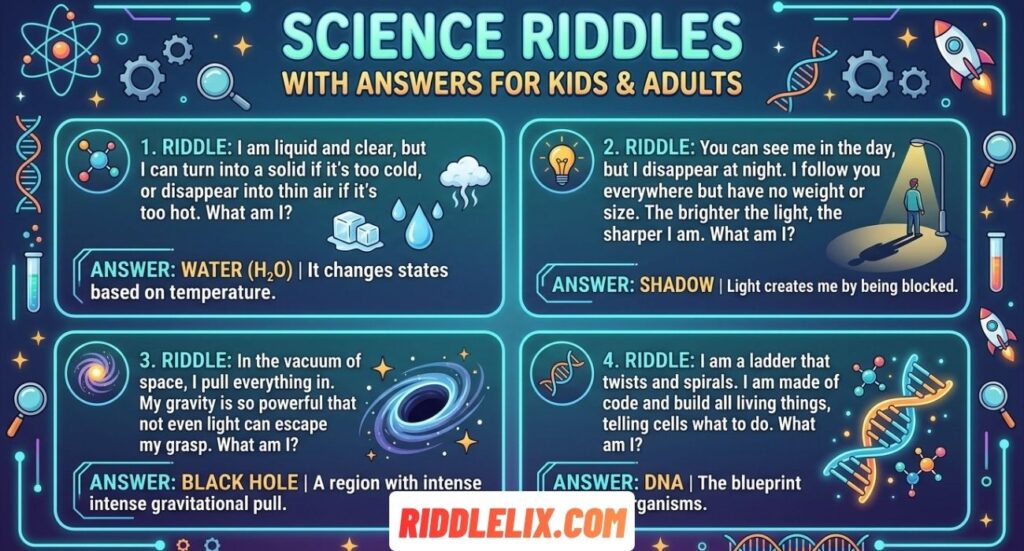
Laughter makes learning better. These funny science riddles with answers will make kids and adults giggle while thinking about science. They combine jokes with facts to create a memorable learning experience. Use them to break the ice in class or at parties.
- Why did the physics teacher break up with the biology teacher?
Answer: Because there was no chemistry between them. Chemistry is the study of matter interactions, and the joke plays on romantic chemistry. - What did the cell say when his sister stepped on his foot?
Answer: Ouch, mitosis! Mitosis is the process of cell division, and the joke plays on the word my toe sis. - Why can’t you trust an atom?
Answer: Because they make up everything. Atoms literally compose all matter, and the joke plays on the phrase make up meaning to fabricate. - What do you call a dog that can do magic?
Answer: A labracadabrador. This pun combines Labrador with abracadabra, the magical word. - Why did the mushroom go to the party alone?
Answer: Because he was a fungi. Fungi sounds like fun guy, creating a classic science pun. - What did one volcano say to the other?
Answer: I lava you. Lava is molten rock that erupts from volcanoes, and it sounds like love you. - Why are chemists great at solving problems?
Answer: Because they have all the solutions. In chemistry, a solution is a homogeneous mixture, and the word also means answer. - What did the DNA say to the other DNA?
Answer: Do these genes make me look fat? Genes are segments of DNA, and the joke plays on the word jeans. - Why did the bacteria cross the microscope?
Answer: To get to the other slide. Bacteria are studied on microscope slides, and the joke parodies the chicken crossing the road. - What do you call a fish with no eyes?
Answer: A fsh. Removing the letter i from fish makes fsh, and the letter i sounds like eye. - Why did the sun go to school?
Answer: To get brighter. The sun produces light and heat, and brighter also means smarter. - What do you get when you mix sulfur, tungsten, and silver?
Answer: SWAG. The chemical symbols for sulfur, tungsten, and silver are S, W, and Ag, which spell SWAG. - How do you organize a space party?
Answer: You planet. Planet sounds like plan it, making a clever astronomy pun. - What did the limestone say to the geologist?
Answer: Don’t take me for granite. Granite is another type of rock, and the phrase plays on take for granted. - Why did the bear dissolve in water?
Answer: Because it was a polar bear. Polar molecules dissolve in water, and polar bears live in cold regions, creating a double meaning.
Science Riddles For Adults
These science riddles for adults are more challenging and cover advanced topics in physics, chemistry, biology, and astronomy. They require deeper knowledge and critical thinking. Perfect for trivia nights, college students, and science enthusiasts who want a real mental workout.
- I am the only element that can exist as a liquid at room temperature without being artificially cooled. What am I?
Answer: Mercury. Mercury has a melting point of negative 38 degrees Celsius, making it liquid at standard room temperature. - I am a region in space where gravity is so strong that even light cannot escape. What am I?
Answer: A black hole. Black holes form when massive stars collapse, creating a singularity with immense gravitational pull. - I am a chemical reaction where a substance gains electrons. What am I called?
Answer: Reduction. Reduction occurs alongside oxidation in redox reactions, involving the gain of electrons by a molecule or atom. - I am the most abundant protein in the human body. What am I?
Answer: Collagen. Collagen provides structural support to skin, bones, tendons, and connective tissues throughout the body. - I am the principle that states you cannot know both the position and momentum of a particle with perfect accuracy. What am I?
Answer: The Heisenberg Uncertainty Principle. This quantum mechanics principle places fundamental limits on measurement precision. - I am the gas that makes up about 78 percent of Earth’s atmosphere. What am I?
Answer: Nitrogen. Nitrogen is the most abundant gas in the atmosphere, essential for building proteins and DNA. - I am the unit of electrical resistance named after a German physicist. What am I?
Answer: The ohm. The ohm measures how strongly a material opposes the flow of electric current in a circuit. - I am the process by which stars produce energy by combining lighter elements into heavier ones. What am I?
Answer: Nuclear fusion. Fusion releases enormous energy by joining atomic nuclei under extreme temperature and pressure. - I am the molecule that carries genetic instructions in all living organisms. What am I?
Answer: Deoxyribonucleic acid or DNA. DNA stores biological information using a code made of four chemical bases. - I am the phenomenon where light separates into different colors when passing through a prism. What am I?
Answer: Dispersion. Dispersion occurs because different wavelengths of light travel at different speeds through a medium. - I am the force that causes moving objects on Earth to curve due to the planet’s rotation. What am I?
Answer: The Coriolis effect. This effect influences weather patterns and ocean currents by deflecting moving air and water. - I am the smallest particle of an element that retains its chemical properties. What am I?
Answer: An atom. Atoms consist of a nucleus surrounded by electrons and are the fundamental units of chemical elements. - I am the state of matter found in lightning and the sun. What am I?
Answer: Plasma. Plasma is an ionized gas consisting of free electrons and ions, making it electrically conductive. - I am the law that states energy cannot be created or destroyed, only transformed. What am I?
Answer: The first law of thermodynamics. Also called the law of conservation of energy, it governs all energy transfers in the universe. - I am the subatomic particle with no electric charge found in the nucleus of an atom. What am I?
Answer: A neutron. Neutrons add mass to the nucleus and play a key role in nuclear stability and reactions.
Hard Science Riddles With Answers
This section features hard science riddles with answers for those who love a serious mental challenge. These puzzles require deeper knowledge of advanced scientific concepts, including quantum physics, molecular biology, and astrophysics. They are perfect for college students, science teachers, and trivia champions who want to test their expertise.
- I am a hypothetical particle that travels faster than light. What am I called?
Answer: A tachyon. Tachyons are theoretical particles that would exceed the speed of light, though no evidence confirms their existence. - I am the process by which a solid changes directly into a gas without becoming a liquid first. What am I?
Answer: Sublimation. Dry ice undergoes sublimation, turning from solid carbon dioxide directly into gas at room temperature. - I am the type of bond formed when atoms share electron pairs. What am I?
Answer: A covalent bond. Covalent bonds create stable molecules like water and carbon dioxide through shared electrons. - I am the law that explains why a moving bicycle stays upright. What am I?
Answer: Angular momentum. The spinning wheels create angular momentum that resists changes to the bicycle’s orientation. - I am the genetic phenomenon where one gene influences multiple unrelated traits. What am I?
Answer: Pleiotropy. Pleiotropic genes can affect several different physical characteristics in an organism simultaneously. - I am the temperature at which all molecular motion theoretically stops. What am I?
Answer: Absolute zero. Absolute zero equals negative 273.15 degrees Celsius or zero Kelvin, the lowest possible temperature. - I am the subatomic particle that gives other particles mass. What am I?
Answer: The Higgs boson. The Higgs boson interacts with other particles through the Higgs field, giving them mass. - I am the phenomenon where light bends around massive objects in space. What am I?
Answer: Gravitational lensing. Massive objects like galaxies warp spacetime, bending light from objects behind them. - I am the type of rock formed from compressed sediments over millions of years. What am I?
Answer: Sedimentary rock. Sedimentary rocks like sandstone form from layers of sand, silt, and organic material. - I am the process where organisms better adapted to their environment survive and reproduce. What am I?
Answer: Natural selection. Charles Darwin proposed natural selection as the primary mechanism driving evolution. - I am the force that holds protons and neutrons together in an atomic nucleus. What am I?
Answer: The strong nuclear force. This fundamental force overcomes electromagnetic repulsion between positively charged protons. - I am the unit used to measure radioactive decay. What am I?
Answer: The becquerel. One becquerel equals one radioactive decay event per second. - I am the phenomenon where two particles become linked and instantly affect each other regardless of distance. What am I?
Answer: Quantum entanglement. Entangled particles share a quantum state, so measuring one instantly determines the other. - I am the most common isotope of hydrogen, containing one proton and one neutron. What am I?
Answer: Deuterium. Deuterium is stable and occurs naturally in ocean water, used in nuclear fusion research. - I am the theory that explains the origin of the universe from a single point. What am I?
Answer: The Big Bang theory. The universe expanded from an extremely hot and dense state approximately 13.8 billion years ago.
Easy Science Riddles For Beginners
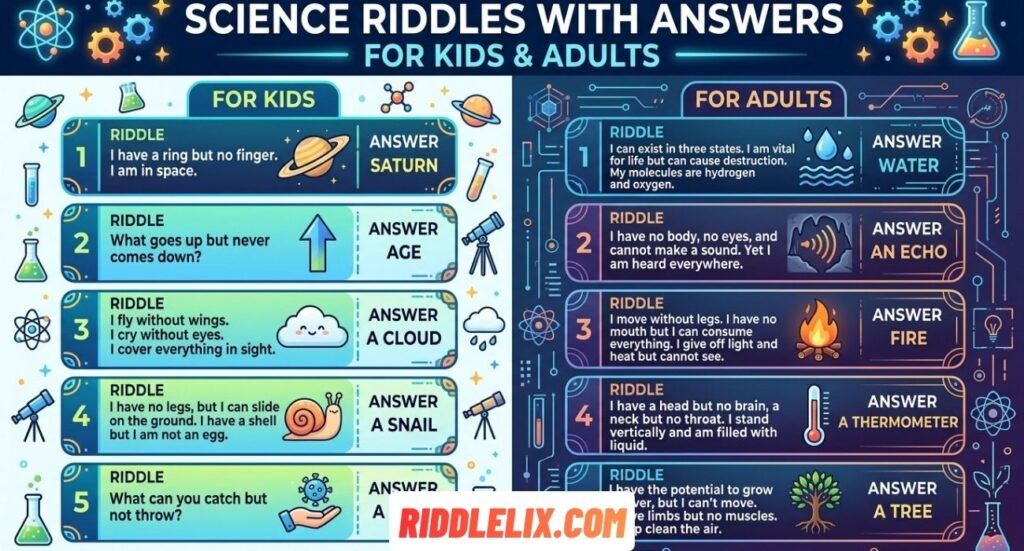
These easy science riddles for beginners are perfect for anyone new to science puzzles. The questions use simple language and familiar concepts that anyone can understand. They are great for elementary students, ESL learners, and families who want to enjoy science together without stress.
- I am the red planet. What am I?
Answer: Mars. Mars appears red because iron oxide or rust covers its surface. - I am the liquid you drink every day to stay alive. What am I?
Answer: Water. The human body is about 60 percent water, making hydration essential for health. - I am the organ that pumps blood through your body. What am I?
Answer: The heart. The heart beats about 100,000 times each day to circulate blood. - I am the gas that fills balloons and makes them float. What am I?
Answer: Helium. Helium is lighter than air, so balloons filled with helium rise upward. - I am the season after winter when flowers start to bloom. What am I?
Answer: Spring. Spring brings warmer temperatures and longer days as Earth tilts toward the sun. - I am the part of the plant that grows underground. What am I?
Answer: The root. Roots anchor plants in soil and absorb water and nutrients. - I am the bright object you see in the sky during the day. What am I?
Answer: The sun. The sun is a star at the center of our solar system that provides light and heat. - I am the animal that says moo and gives us milk. What am I?
Answer: A cow. Cows are mammals that produce milk to feed their calves and provide dairy for humans. - I am the force that keeps your feet on the ground. What am I?
Answer: Gravity. Gravity pulls objects toward Earth’s center, preventing you from floating away. - I am the cold white stuff that falls from the sky in winter. What am I?
Answer: Snow. Snow forms when water vapor in clouds freezes into ice crystals before falling. - I am the organ you use to see. What am I?
Answer: The eye. The eye focuses light onto the retina to create images sent to the brain. - I am the sound a dog makes. What am I?
Answer: A bark. Dogs communicate through barking, growling, and other vocalizations. - I am the color of grass in summer. What am I?
Answer: Green. Grass appears green because chlorophyll in plant cells reflects green light. - I am the planet with the big red spot. What am I?
Answer: Jupiter. The Great Red Spot is a giant storm on Jupiter larger than Earth. - I am the animal that flies and makes honey. What am I?
Answer: A bee. Bees collect nectar from flowers and convert it into honey in their hives.
Science Riddles For Middle Schoolers
This section offers science riddles for middle schoolers who are ready for more challenging concepts. These puzzles align with middle school science curriculum topics including the periodic table, ecosystems, energy, and the human body. They are ideal for students in grades six through eight.
- I am the process where a liquid turns into vapor at the surface. What am I?
Answer: Evaporation. Evaporation occurs when molecules gain enough energy to escape from a liquid’s surface. - I am the organelle known as the powerhouse of the cell. What am I?
Answer: The mitochondrion. Mitochondria produce ATP, the energy currency used by cells for all functions. - I am the sixth element on the periodic table and the basis of all life. What am I?
Answer: Carbon. Carbon forms four chemical bonds, allowing it to create complex molecules like proteins and DNA. - I am the layer of Earth between the crust and the core. What am I?
Answer: The mantle. The mantle is a thick layer of hot rock that flows slowly and drives plate tectonics. - I am the process where organisms convert sugar into energy using oxygen. What am I?
Answer: Cellular respiration. This process releases energy stored in glucose to power cellular activities. - I am the type of energy stored in a stretched rubber band. What am I?
Answer: Elastic potential energy. Stretching or compressing an object stores energy that is released when it returns to shape. - I am the planet with the most moons in our solar system. What am I?
Answer: Saturn. Saturn has over 140 known moons, more than any other planet. - I am the blood cells that help fight infection. What am I?
Answer: White blood cells. These cells identify and destroy pathogens like bacteria and viruses. - I am the force that causes a moving object to slow down on a rough surface. What am I?
Answer: Friction. Friction between surfaces converts kinetic energy into heat and resists motion. - I am the ecosystem found where freshwater meets the ocean. What am I?
Answer: An estuary. Estuaries support diverse wildlife and serve as nurseries for many marine species. - I am the type of chemical reaction that absorbs heat from the surroundings. What am I?
Answer: Endothermic reaction. Endothermic reactions like photosynthesis take in energy, making their surroundings cooler. - I am the structure in plant cells that captures sunlight for photosynthesis. What am I?
Answer: The chloroplast. Chloroplasts contain chlorophyll, the pigment that absorbs light energy. - I am the scale used to measure the magnitude of earthquakes. What am I?
Answer: The Richter scale. The Richter scale measures seismic wave amplitude to quantify earthquake strength. - I am the gas produced by plants during photosynthesis. What am I?
Answer: Oxygen. Plants release oxygen as a byproduct when converting carbon dioxide and water into glucose. - I am the simple machine that uses a wheel and a rope to lift heavy objects. What am I?
Answer: A pulley. Pulleys reduce the force needed to lift loads by changing the direction of applied force.
Science Riddles About Space And The Universe
These science riddles about space and the universe explore planets, stars, galaxies, and cosmic phenomena. Space fascinates people of all ages, making these puzzles exciting for students, adults, and amateur astronomers. They combine astronomy facts with creative thinking challenges.
- I am the closest star to Earth. What am I?
Answer: The sun. The sun is about 93 million miles away and provides the energy that sustains life on Earth. - I am a cloud of gas and dust where new stars are born. What am I?
Answer: A nebula. Nebulae are stellar nurseries where gravity pulls gas and dust together to form stars. - I am the force that keeps planets orbiting the sun. What am I?
Answer: Gravity. The sun’s massive gravitational pull holds all planets in stable orbits around it. - I am the brightest planet in the night sky, often called the morning star. What am I?
Answer: Venus. Venus reflects sunlight strongly due to its thick cloud cover, making it extremely bright. - I am the galaxy that contains our solar system. What am I?
Answer: The Milky Way. The Milky Way is a spiral galaxy containing billions of stars, planets, and other celestial objects. - I am the phenomenon where the moon passes between the sun and Earth, blocking sunlight. What am I?
Answer: A solar eclipse. During totality, the moon completely covers the sun, creating darkness during the day. - I am the largest planet in our solar system. What am I?
Answer: Jupiter. Jupiter is so large that over 1,300 Earths could fit inside it. - I am the red supergiant star in the constellation Orion. What am I?
Answer: Betelgeuse. Betelgeuse is nearing the end of its life and will eventually explode as a supernova. - I am the dwarf planet formerly classified as the ninth planet. What am I?
Answer: Pluto. Pluto was reclassified as a dwarf planet in 2006 by the International Astronomical Union. - I am the stream of charged particles constantly flowing from the sun. What am I?
Answer: The solar wind. Solar wind interacts with Earth’s magnetic field to create auroras near the poles. - I am the type of eclipse that occurs when Earth passes between the sun and moon. What am I?
Answer: A lunar eclipse. The moon appears red during a total lunar eclipse because Earth’s atmosphere bends sunlight. - I am the spacecraft that carried humans to the moon for the first time. What am I?
Answer: Apollo 11. Apollo 11 landed Neil Armstrong and Buzz Aldrin on the moon on July 20, 1969. - I am the point in space where the gravitational pull of two bodies balances. What am I?
Answer: A Lagrange point. Lagrange points allow spacecraft to maintain stable positions with minimal fuel use. - I am the phenomenon where a star explodes at the end of its life. What am I?
Answer: A supernova. Supernovae release enormous amounts of energy and create heavy elements like gold and iron. - I am the telescope that orbits Earth and captures stunning images of deep space. What am I?
Answer: The Hubble Space Telescope. Hubble has provided groundbreaking images of galaxies, nebulae, and other cosmic objects since 1990.
Science Riddles About The Human Body
These science riddles about the human body teach fascinating facts about anatomy, physiology, and health. The human body is an amazing machine with countless mysteries to explore. These puzzles are perfect for biology students, health classes, and anyone curious about how their body works.
- I am the largest organ of the human body. What am I?
Answer: The skin. Skin covers about 20 square feet and protects the body from infection, dehydration, and temperature changes. - I am the bone that protects your brain. What am I?
Answer: The skull. The skull is made of 22 bones fused together to form a protective case for the brain. - I am the muscle that helps you breathe. What am I?
Answer: The diaphragm. The diaphragm contracts and relaxes to pull air into and push air out of the lungs. - I am the longest bone in the human body. What am I?
Answer: The femur. The femur connects the hip to the knee and supports the weight of the upper body. - I am the liquid that carries oxygen to every cell in your body. What am I?
Answer: Blood. Red blood cells contain hemoglobin, which binds to oxygen and transports it throughout the body. - I am the organ that filters waste from your blood. What am I?
Answer: The kidney. Kidneys filter about 50 gallons of blood daily, producing urine to remove waste products. - I am the nerve that connects the eye to the brain. What am I?
Answer: The optic nerve. The optic nerve transmits electrical signals from the retina to the visual cortex in the brain. - I am the smallest bone in the human body, located in the ear. What am I?
Answer: The stapes. The stapes is about 3 millimeters long and helps transmit sound vibrations to the inner ear. - I am the part of the brain that controls balance and coordination. What am I?
Answer: The cerebellum. The cerebellum fine-tunes motor movements and helps maintain posture and equilibrium. - I am the type of joint found in your shoulder and hip. What am I?
Answer: A ball-and-socket joint. This joint allows movement in multiple directions, providing the widest range of motion. - I am the pigment that gives skin, hair, and eyes their color. What am I?
Answer: Melanin. More melanin produces darker skin tones, protecting against ultraviolet radiation damage. - I am the chemical messenger that regulates body functions like growth and mood. What am I?
Answer: A hormone. Hormones like insulin, adrenaline, and estrogen travel through the bloodstream to target organs. - I am the system that defends the body against germs and diseases. What am I?
Answer: The immune system. White blood cells, antibodies, and lymph nodes work together to fight infections. - I am the process by which the body maintains a stable internal temperature. What am I?
Answer: Thermoregulation. Sweating cools the body while shivering generates heat to keep core temperature stable. - I am the part of the cell that contains your unique genetic code. What am I?
Answer: The nucleus. The nucleus houses DNA organized into chromosomes that determine inherited traits.
Conclusion
Science riddles are more than just fun games. They help you learn important concepts in physics, chemistry, biology, and astronomy while exercising your brain. Whether you are a kid just starting to explore science or an adult looking for a challenge, these puzzles offer something valuable for everyone.
By solving these riddles about science, you improve your problem-solving skills, critical thinking, and memory. Teachers can use them in classrooms to make lessons exciting. Parents can share them at dinner to spark curiosity. Friends can challenge each other during game nights for healthy competition.
We hope this collection of science riddles with answers has entertained you and taught you something new. Keep asking questions, stay curious, and never stop exploring the amazing world of science. Try creating your own riddles and share them with others to spread the joy of learning.